





 Strategies for the Classroom
$20 | 90 min
SKU: TR10112
Summary
In the PD series "Application of the Power of Music," the focus shifts from understanding the power of music to applying it effectively in the classroom. The series emphasizes engaging all students, particularly neurodiverse learners, in music education. Drawing on both personal experiences and established educational principles, the series advocates for individualized approaches to teaching, encouraging educators to build strong relationships with special educators and parents. By gathering insights into each student’s unique needs, teachers can create an inclusive environment where neurodiverse students thrive.
This professional development is the last course in the music therapy collection.
This course, The Music Classroom: Environment, Strategies, and Management, provides educators with essential strategies for creating inclusive music classroom environments tailored to the diverse needs of neurodiverse students. It emphasizes practical approaches for setting up physical spaces and implementing effective teaching techniques grounded in music therapy. Key topics include preparing equipment in advance, arranging seating according to individual needs, minimizing distractions, and establishing consistent routines. Educators will learn to use musical transitions and visual schedules to enhance student engagement and reduce anxiety while exploring adaptations for instruments to ensure all students can participate successfully.
Objectives
By the end of this course, participants will be able to:
- Identify and implement at least two physical or environmental changes in the music classroom to enhance inclusivity for neurodiverse students.
- Develop and apply effective classroom management strategies that promote positive behavior through reinforcement and clear communication.
- Adapt musical instruments and notation to accommodate students with varying physical and cognitive abilities, ensuring successful participation for all learners.
- Utilize musical transitions and visual schedules to enhance student engagement and reduce anxiety during class activities.
- Create consistent routines that support a structured learning environment, benefiting both students and educators.
The course will employ a mix of lectures, demonstrations, and interactive applications to facilitate learning.
"Hello! My name is Melissa Reinhardt and I am a board certified music therapist. I am here to let you know about a new course offered by MusicConstructED called “Making the Most of the Power of Music.” I am very excited to be offering this course and I hope you will join me as we learn about the how’s and why’s of the power of music. With over a 30 year career in music therapy, I will be sharing my knowledge with you in 3 main sections: Music Therapy and Music Education, The Power of Music and finally, the application of the power of music. In the application portion of this course, I will be sharing information specific to neurodiverse learners. I hope that you will join me!"
Here is the class outline:
IntroductionMeet Melissa Reinhardt, a board-certified music therapist with over 30 years of experience. Understand what you’ll learn in the Music Therapy Collection. Review the course overview to understand the specific classroom environment, teaching strategies, and behavior management techniques you'll implement. 3 sections
|
|||
|
Music Classroom EnvironmentExplore how your classroom environment affects student behavior and learning with strategies for music spaces. Learn to prepare materials effectively, arrange seating for 504/IEP needs, minimize distractions, and ensure safety. Discover accessibility considerations for middle and high school, including managing risers, removing obstructions, and creating visual rehearsal plans for all learners. 6 sections
|
||||||
|
Classroom Teaching StrategiesExplore effective classroom teaching strategies grounded in music therapy that promote participation for all students. Learn to implement engaging transitions using both musical and non-musical methods, create visual schedules to enhance predictability and reduce anxiety, and adapt instruments to cater to diverse needs by utilizing both commercial products and DIY strategies. Additionally, discover adapted notation techniques that utilize color coding and visual aids, enabling students to create music without traditional notation, while ensuring that adaptations enhance learning outcomes and maintain the objective. 8 sections
|
||||||||
|
General Classroom ManagementExplore the factors contributing to behavioral problems in today's students, including dysregulation, trauma, attention-seeking behaviors, and power struggles. Recognize that no single technique is suitable for every student. Discover proactive strategies for effective classroom management, such as assuming competence and offering specific praise. Learn three behavioral techniques—planned ignoring, signal interference, and proximity control—that redirect negative behaviors discreetly, and how to collaborate with special education teams on Functional Behavior Assessments and Behavior Intervention Plans. 8 sections
|
||||||||
|
ConclusionFind out how to continue your learning and complete our On Demand survey to help us further the Music ConstructED Online Learning experience. 3 sections
|
|||
|
Completion
The following certificates are awarded when the class is completed:
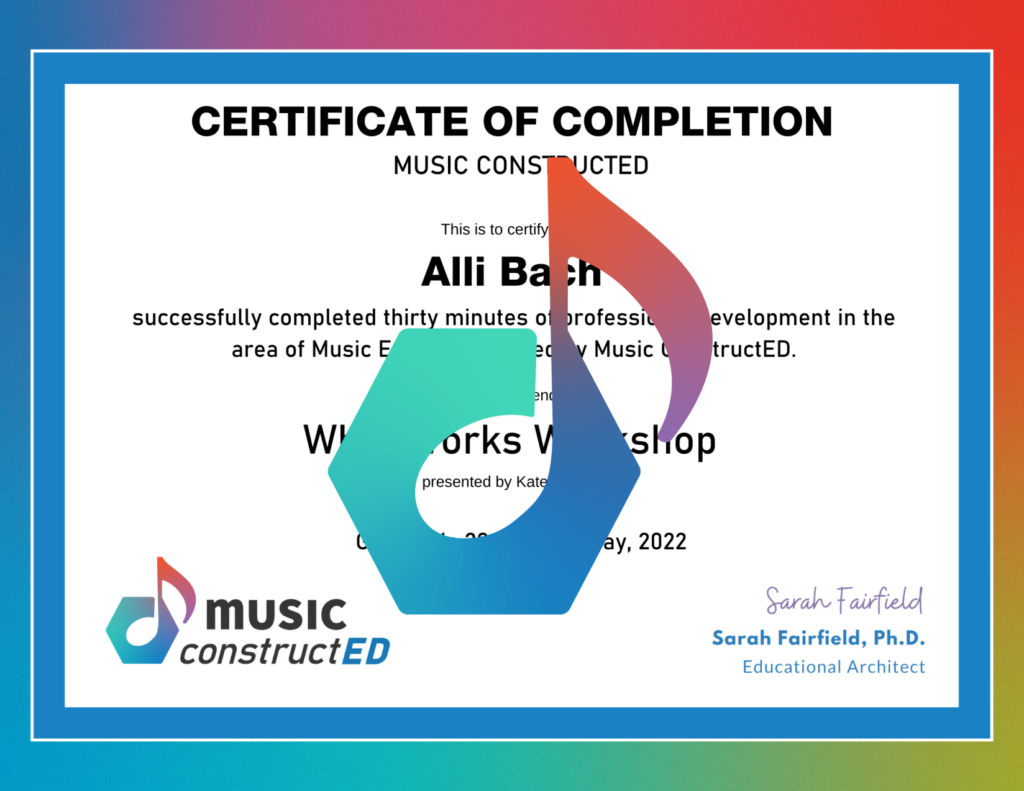 |
Music ConstructED 90-minute PD Certificate of Completion |